
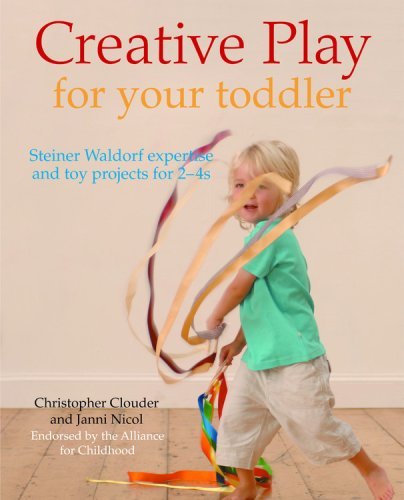
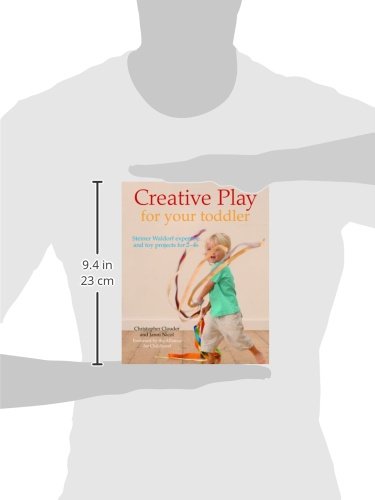
Creative Play for Your Toddler: Steiner Waldorf Expertise and Toy Projects for 2 – 4s
$21.04
Related Products

Give your kids more than a diet of television and plastic toys with this inspiring course. Following hot on the heels of the hugely popular Creative Play for your Baby, this is the ideal resource for modern parents who want their children to expand their creativity and imagination through play. Discover child development according to the Steiner theory, which helps toddlers realize themselves both naturally and holistically in mind, body, and spirit. Each chapter deals with a different element of your child’s growth and includes an expert summary of the theory that goes behind it. You’ll find step-by-step instructions for making over 20 beautiful toys from natural materials to help your child develop resourcefulness, originality, awareness, and confidence.
Publisher : Gaia
Publication date : July 1, 2006
Language : English
Print length : 352 pages
ISBN-10 : 1856752860
ISBN-13 : 978-1856752862
Item Weight : 13.8 ounces
Dimensions : 7.63 x 0.38 x 9.38 inches
Grade level : Preschool and up
Best Sellers Rank: #2,192,273 in Books (See Top 100 in Books) #2,110 in Family Activity
Customer Reviews: 4.1 4.1 out of 5 stars (53) var dpAcrHasRegisteredArcLinkClickAction; P.when(‘A’, ‘ready’).execute(function(A) { if (dpAcrHasRegisteredArcLinkClickAction !== true) { dpAcrHasRegisteredArcLinkClickAction = true; A.declarative( ‘acrLink-click-metrics’, ‘click’, { “allowLinkDefault”: true }, function (event) { if (window.ue) { ue.count(“acrLinkClickCount”, (ue.count(“acrLinkClickCount”) || 0) + 1); } } ); } }); P.when(‘A’, ‘cf’).execute(function(A) { A.declarative(‘acrStarsLink-click-metrics’, ‘click’, { “allowLinkDefault” : true }, function(event){ if(window.ue) { ue.count(“acrStarsLinkWithPopoverClickCount”, (ue.count(“acrStarsLinkWithPopoverClickCount”) || 0) + 1); } }); });
10 reviews for Creative Play for Your Toddler: Steiner Waldorf Expertise and Toy Projects for 2 – 4s
Add a review
$21.04
KT –
Opens Many Doors
This book has enough concrete instructions (for toy projects) and philosophical context to instantly change my parenting. That might be because it connected to things I already believe (peaceful environment, importance of allowing room for imagination) but that the conventional living room full of bright, blinking, beeping, plastic toys overshadows/obliterates, in the absence of a lot of conscious effort. I purchased the book months ago and last week after my 17-month old started having meltdowns when we took away the iPad/iPhone (and learned how to play Angry Birds), I called a moratorium on all electronic toys. This book provides a clear vision of an alternative early childhood. I started with the first project, stuffed rabbits, and found that a secondary benefit is how the book connects me to my own imagination, which helps me to think of how the world might look through his eyes. I have been watching him play more, seeing what he can do, and begun creating these adorable and open-ended play toys for him. It’s amazing…
FroggyMama –
Simple, yet Powerful
I found this book in our local library, and after a week of reading it over and over I realized we needed to own it ourselves. I can’t say exactly what it is about this book that calls to me – it is really a basic introduction to Waldorf principles and a collection of projects that is sizable, but not as many as other toy-crafting books. But for some reason it speaks to me in a way other texts haven’t. The text throughout is beautifully and intelligently written, and contains some wonderful wisdom about childhood and play. The projects, I think, will be wonderful springboards to my creativity and beautiful heirloom toys for my son and future children to enjoy. So while there are other books about toy-making and Waldorf principles that are much more involved, I think this simple book will be one I refer to most, simply to be enlightened and refreshed.
M. W. –
The projects have definitely inspired different choices in materials that I’d like to use in my classroom
This book contains project ideas and an overview of the Steiner approach to learning. Don’t be intimidated if you don’t sew or saw or hammer ( me neither, I only sew a little). The projects have definitely inspired different choices in materials that I’d like to use in my classroom.
Emily –
Valuable Information
This book is a good introduction to the Waldorf philosophy regarding play in the toddler/pre-school years. I love Waldorf’s emphasis on natural materials and imagination, which is severely lacking in today’s toy stores filled with flashing, moving, blaring, plastic “learning” toys. Whenever I do find simple toys made of natural materials, they are almost always too expensive for me. (Especially those Waldorf dolls! YIKES!) Now I can learn how to make these simple toys myself with less of a monetary investment in the materials than if I were to buy the finished product. And I don’t feel guilty substituting less natural, quality materials for cheaper ones if I need to, because it will still be much better than anything I can find in stores. (For example, using recycled plastic felt instead of 100% wool felt.) I was disappointed to read one review where the mother was overwhelmed with the directions of making these toys, so is giving the book away. Even if you do not make any of these toys, there is valuable information on play in the toddler years that is worth the read.
Kristin –
Ok, some cute ideas
Firstly, we are a waldorf style family, so thought this book might be nice. It’s cute, has a few lovely ideas for toys, but it’s a bit pointless in our house. Most of the ideas are pretty obvious and/or things we’ve already done or thought of. I’d imagine if you were truly not creative at all, or totally unused to playing in and with nature then maybe this would be great. But I found the whole thing a bit obvious, and that I’d actually made many of the toys in the book already!
Amazon Customer –
Yes, it requires effort. Yes, it’s worth it.
A few minutes of Googling would have saved the one-star critics some grief. Steiner Waldorf toys are, by definition, handmade from all natural materials. No, the projects in this book are not meant to be completed by your child. You make them and your child plays with them, just like it says in the product description. If you’re not somewhat interested in Waldorf principles, and somewhat crafty, this is not the book for you.But if you want to provide your child with aesthetically pleasing open-ended playthings, without spending a fortune, this is a wonderful resource. Most of the projects can be completed in an hour or less, and can be modified, with a little imagination, to suit the materials you have at hand. Best of all, each chapter includes an overview of the qualities these toys are meant to encourage. The summary of interaction is particularly powerful and integral to Waldorf methods.
Claire –
Some good ideas
Cakegrrrl –
I was hoping this book had projects that you do WITH your toddler, not FOR your toddler. Warning not to get it if that was what you are looking for! If you are crafty and want/have time to make your own toys from natural materials and avoid plastic then this might still be great for you. The theory bits are good but can be found in lots of other Steiner inspired books. Haven’t read it from cover to cover so can’t fully review yet, but the fact that it dropped to the bottom of my childhood development/parenting book list says something for me.
Enya White –
Lovely ideas
Marzipanda –
This is a lovely book with good instructions for the toys and excellent photographs. However having looked into the Steiner Waldorf method I personally would steer well clear of the schools and teaching methods. The toys in this book however would be suitable for all young children.